
Mass Tort vs. Class Action: What Is the Real Difference?
Navigating the legal world after an injury or financial loss can feel overwhelming, especially when you encounter terms like mass tort and class action. While both allow groups of people to seek justice against a powerful corporate defendant, they operate under fundamentally different rules. If you or a loved one has suffered harm, understanding these differences is crucial to securing the compensation you deserve. As a personal injury law firm in Baltimore, Murphy, Falcon & Murphy helps individuals stand up to negligent corporations and get the personalized representation they need.
Here is what you need to know about mass tort vs. class action lawsuits and how they impact your potential claim. Schedule a consultation today.

Individual Claims vs. A Single Lawsuit
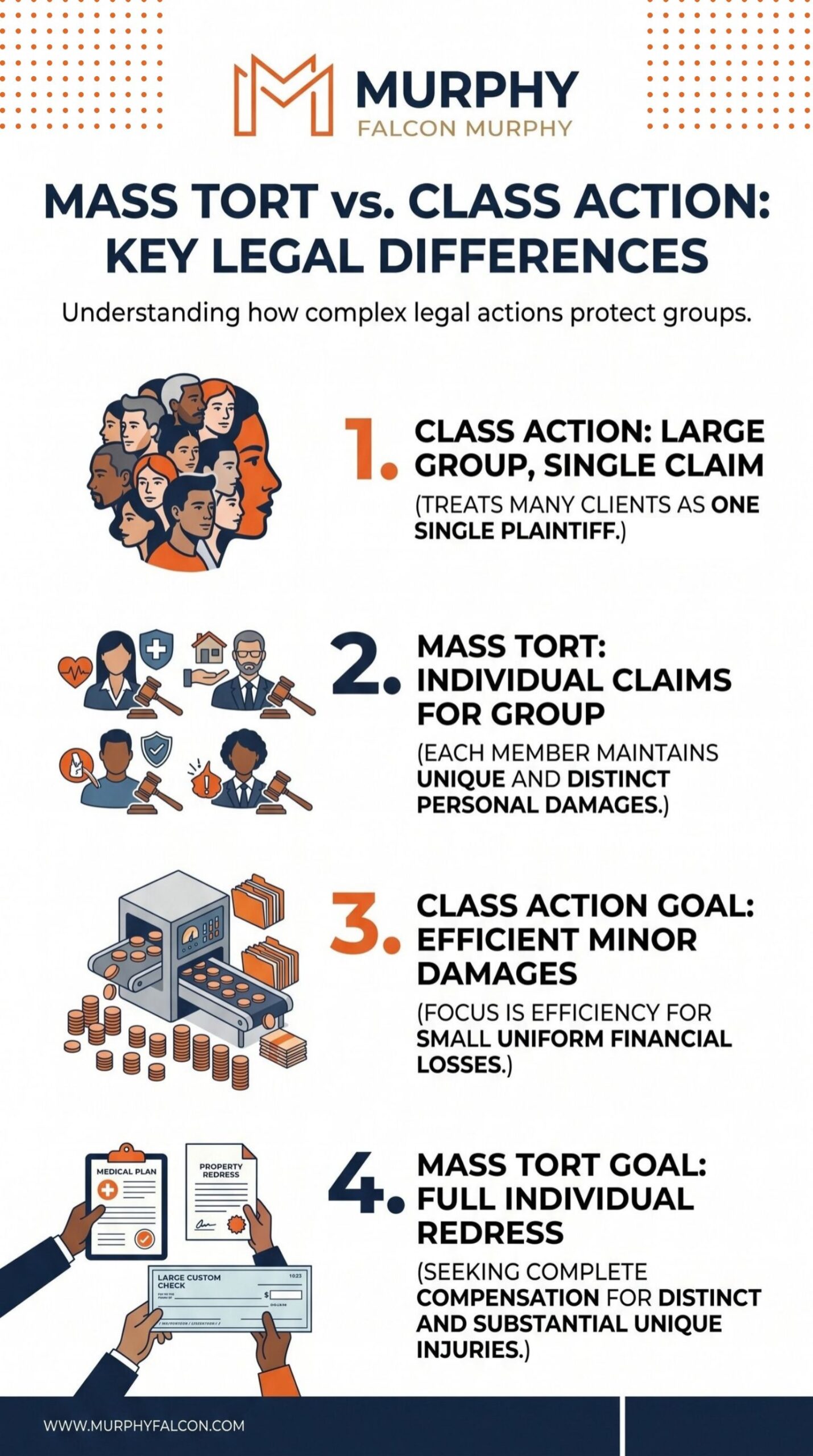
In a class action, a few representative plaintiffs sue on behalf of a large group who experienced nearly identical harm. Everyone in the class is treated as a single entity, resulting in one blanket verdict or settlement. In contrast, mass tort cases involve individuals who experienced varied degrees of harm. Even though mass tort cases are grouped together for pre-trial proceedings to streamline evidence, your lawsuit remains entirely your own.

Customized Damages vs. Equal Payouts
Because class actions treat the group as one, the final settlement is typically split evenly among all members, often resulting in modest payouts. Mass tort cases handle damages differently. Because injuries from defective medical devices or toxic exposures range from minor to catastrophic, a mass tort attorney presents your specific medical bills, lost wages, and pain and suffering to secure compensation tailored to your exact injuries.

Grouping by Location vs. Nationwide Reach
Class actions often deal with widely distributed, uniform issues like deceptive billing, privacy breaches, or consumer product mislabeling. Mass torts frequently focus on complex, high-stakes personal injury claims—such as dangerous prescription drugs or environmental contamination—where victims across different regions suffer distinct, severe health complications.

How Evidence Is Handled
In a class action, key evidence applies universally across the entire class. In mass tort litigation, while shared evidence regarding corporate negligence is gathered collectively, a tort lawyer must build a distinct file proving how that specific product or negligence directly caused your personal injuries.

Court Approval and Opt-Out Requirements
A class action requires a judge to certify the class before it can move forward, and individual members are automatically included unless they opt out. Mass torts do not require class certification. Each claim is filed individually, giving you direct control over whether to accept a settlement or proceed.
CALL A LAWYER TODAY
Choosing the right legal path depends entirely on the specific details of your situation. If you suspect that a defective product, dangerous drug, or corporate negligence has caused you harm, do not try to evaluate your claim alone. Call a lawyer at Murphy, Falcon & Murphy today to discuss your options with a skilled class action lawyer and mass tort team ready to protect your rights.